Which Housing Type Would You Choose During Retirement?
Housing Types For Retirement.
Let’s talk about something that sneaks up on most of us:
In which type of residence would you prefer to stay once you retire?
It’s easy to put this question off. Today the stairs aren’t a problem. The garden still feels manageable. The house still feels like home. But somewhere down the line, most retirees start asking themselves the same thing: is this still the right place for me?
This post isn’t about telling you where to live geographically. That’s a separate conversation, and we’ll get to it another time. Right now, we’re focusing purely on housing types for retirement. What are your actual options, when for now, you strip away the question of which town or suburb?
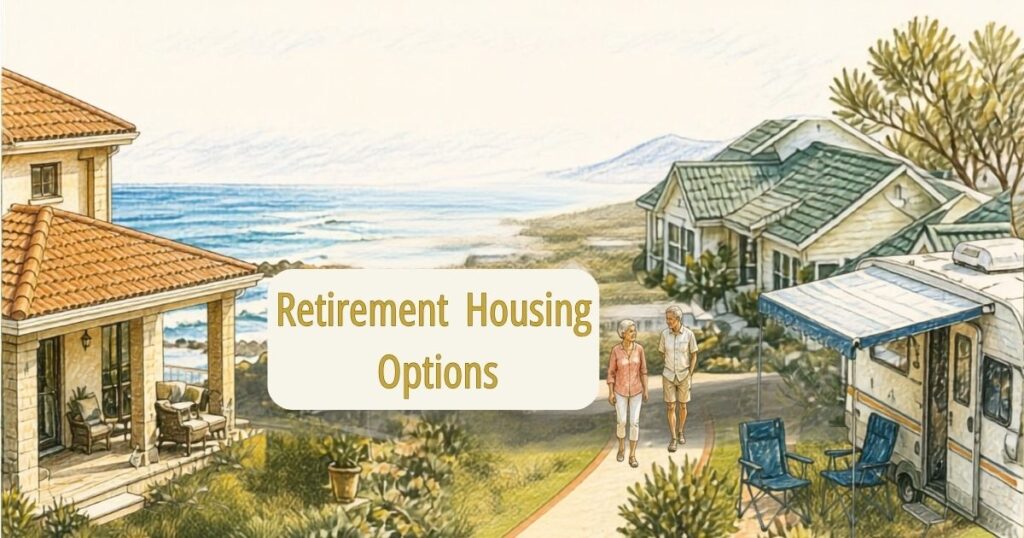
We’ll also weave in a related question that comes up again and again: should you buy or rent? Because in South Africa, that answer isn’t always as simple as it sounds. We have a few uniquely local ownership structures, like life rights and share block schemes, that can catch people off guard if they’ve never encountered them before. We’ll unpack those as we go, so you’re not left scratching your head later.
Grab a cup of tea.- Let me walk you through this.
A Simple Framework for Weighing Your Options
Before we dive into the list, it helps to have a few criteria in mind. Think of these as the questions worth asking yourself about any housing option that comes up:
- Cost. Not just the upfront price, but the ongoing levies, rent, or maintenance costs too.
- Maintenance burden. Who’s going to mow the lawn, fix the geyser, or manage security in five years’ time?
- Independence versus support. If your health needs change, can this option grow with you, or will you need to move again?
- Social connection. Will you be surrounded by people, or could this choice leave you more isolated?
- Flexibility. How easy would it be to sell up, sublet, or relocate if your circumstances change?
- Safety and security. How safe will you actually feel, day to day?
- Proximity to family and services. We’ll cover this properly in a future post, but keep it in the back of your mind as you read.
Hold onto these. We’ll come back to them near the end with a simple way to make it easy for you to visually see the pros and cons involved in the different options.
The Housing Types For Retirement Options
1. Staying in the Family Home
For many retirees, this is the default choice, and honestly, it’s a good one for plenty of people. You know the house. You know the neighbours. There’s comfort in familiar walls.
That said, ageing in place usually means adapting the home a little. Think grab rails in the bathroom, a ramp instead of steps, or converting a downstairs room into a main bedroom so stairs stop being an issue. Some retirees also bring in extra help around the house, whether that’s a gardener, a domestic worker, or eventually a live-in caregiver.
The real question to ask yourself is whether the emotional pull of staying outweighs the practical load of an ageing, and possibly oversized, property.
2. Downscaling to a Smaller Home
This is often the next step after staying put stops making sense. You sell the family home and move into something smaller, whether that’s a compact freestanding house or a sectional title unit.
Here’s where the buy-or-rent question shows up early. Some retirees sell and buy smaller, freeing up a chunk of capital in the process. Others sell and choose to rent instead, which releases even more cash and removes the burden of future maintenance and levies altogether. Neither approach is right or wrong. It really comes down to how much you value owning versus how much you value flexibility and extra capital in the bank.
3. A Gated Estate
Gated estates have grown hugely in popularity, and it’s easy to see why. You get a strong sense of security, often with access control and perimeter fencing, plus a real sense of community.
Within an estate, you might find full-title homes or sectional title units, and each comes with different responsibilities. Some estates lean into a particular lifestyle, think golf estates or eco-estates, which is worth considering if that lifestyle genuinely appeals to you and not just the idea of it. And yes, buying isn’t your only route in. Plenty of estates have an active rental market too, so you can test the lifestyle before committing your capital.
4. A Security Complex or Townhouse Cluster
This is a step down in scale from a full estate, usually a smaller cluster of townhouses sharing perimeter security, but without the extensive shared amenities you’d find in a bigger estate.
It’s worth understanding the levies and homeowner association rules before you sign anything, since these can vary a lot between complexes. And just like with estates, both buying and renting are usually on the table, so it’s worth shopping around for both.
5. A Retirement Village
Retirement villages deserve a bit more unpacking, because South Africa has a few different ownership models, and they’re often confused with one another.
- Life rights give you the right to live in a unit for life, but you don’t own the property itself. When you leave or pass away, the unit reverts to the scheme, though there’s usually some form of payout involved.
- Sectional title means you own your unit outright, just like a regular sectional title apartment.
- Share block schemes give you shares in a company that owns the property, with your shares linked to the right to occupy a specific unit.
- Some villages are rental only, with no ownership component at all.
Beyond ownership, the other big factor is the care continuum. Many villages start you off in independent living, then offer assisted living as your needs grow, and frail care further down the line if it’s ever required. Having that progression available on the same property, without needing to uproot your life again, is a huge part of the appeal for many people.
One thing worth digging into properly, and something people often overlook, is the exit and resale conditions. What happens to your investment if you leave or pass away? How much do you actually get back, and after what deductions? These details differ enormously between villages, so read the fine print carefully.
While researching this section, we came across retirementproperty.co.za, a South African portal that lists verified retirement villages, care facilities, and vacancies around the country. It’s a handy starting point if you want to browse what’s actually out there, from independent living right through to care facilities, all in one place.
6. An Ordinary Apartment Complex
Not every apartment needs to be part of a retirement village. Plenty of retirees simply buy or rent a unit in a regular sectional title complex, no age restrictions, no care facilities attached.
The appeal here is usually urban convenience: shops, medical care, and all amenities close by, plus low maintenance and decent security. The trade-off is that there’s no built-in support system if your health needs change later, and stairs or lifts can eventually become a genuine obstacle. Worth checking early whether the building even has a lift.
7. A Granny Flat
A granny flat, or granny cottage, is a self-contained unit on someone else’s property. There are really two versions of this.
The first is renting a granny flat from an unrelated homeowner, which works a lot like renting any small property, just usually quieter and more private than a typical rental unit. The second is moving into a granny flat on your children’s property, either one that already exists or one built specifically for this purpose.
This second option comes with real financial and emotional upsides, being close to family, built-in support, and lower cost. But it also deserves a clear-eyed conversation about boundaries. Even within families, it helps to put a simple agreement in writing: who pays for what, how much privacy everyone expects, and what happens if circumstances change later. A little structure upfront saves a lot of tension down the line.
8. Long-Stay Camping
Here’s a distinctly South African option that doesn’t get nearly enough attention: long-stay or semi-permanent camping.
Quite a few campgrounds around the country offer favourable tariffs for retirees who commit to a longer stay, often a minimum of one month, with some capping it at three months. A handful of campgrounds go further still, allowing genuinely semi-permanent stays for those who want to base themselves there for much longer stretches.
For retirees who love the outdoors, enjoy a strong sense of community, and want the freedom to move around the country as the seasons change, this can be a wonderfully affordable and social lifestyle. The trade-offs are fairly obvious though: limited space, and less straightforward access to healthcare if you’re settled somewhere remote. Still, for the right personality, it’s a genuinely appealing way to spend this chapter of life.
9. A Few More Worth Considering
To round things out, here are three options that don’t always make the standard lists, but deserve a mention as optional housing types for retirement.
- Co-housing or house-sharing. Splitting a home with a friend, sibling, or fellow retiree can spread costs significantly, and it comes with the added bonus of daily company.
- Assisted living or frail care facilities. Distinct from independent living in a retirement village, these are built specifically for retirees who need a higher level of day-to-day care.
- Renting on the open market by choice. Some retirees sell their home and simply rent an ordinary house or apartment, not out of financial necessity, but because they’d rather have the freedom and flexibility renting provides.
Buy or Rent?
We’ve touched on buying versus renting throughout, but it deserves its own moment, because it’s genuinely one of the biggest decisions in this whole process.
Buying ties up your capital, but it builds equity and gives you long-term stability. Renting frees up cash and gives you the flexibility to move again if your needs change, though obviously without building equity over time.
Then there’s the local twist. South Africa’s ownership structures- freehold, sectional title, life rights, and share block- all affect what you actually walk away with when you eventually sell or leave. Life rights, in particular, catch people out because they feel like ownership, yet legally, they aren’t. It’s worth having a frank conversation with a financial adviser about how each structure affects your estate planning too, since inheritance implications differ quite a bit between them. We’ll dig into that in more detail in a future post.
How to Decide: A Practical Checklist
By now you’ve got a long list of options, so how do you actually narrow it down?
Start by revisiting the criteria from earlier: cost, maintenance, independence, social connection, flexibility, security, and proximity to family. Sit down and score each option you’re considering against these, even roughly out of ten. Patterns tend to emerge quickly once you do this.
Ask yourself a few honest questions too. What’s your realistic budget, not just today, but in ten years? How’s your health outlook, and how might that change? Do you thrive on community, or do you need more solitude than most? And how close do you genuinely want, or need, to be to family?
Compare Your Options at a Glance
Use this table alongside the criteria above. Each rating is a general guide, not a fixed rule, since real-world costs and conditions vary between specific properties.
| Housing Option | Cost | Maintenance Burden | Care & Support | Social Connection | Flexibility | Security |
|---|---|---|---|---|---|---|
| Staying in the Family Home | Medium | High | Low | Medium | Low | Medium |
| Downscaling to a Smaller Home | Medium | Medium | Low | Medium | Medium | Medium |
| Gated Estate | High | Medium | Low | High | Medium | High |
| Security Complex | Medium | Low | Low | Medium | Medium | High |
| Retirement Village | High | Low | High | High | Low | High |
| Ordinary Apartment Complex | Medium | Low | Low | Medium | High | Medium |
| Granny Flat | Low | Low | Medium | Medium | Medium | Medium |
| Long-Stay Camping | Low | Low | Low | High | High | Low |
| Co-housing / House-Sharing | Medium | Medium | Medium | High | Medium | Medium |
| Assisted Living / Frail Care | High | Low | High | Medium | Low | High |
| Renting on the Open Market | Medium | Low | Low | Medium | High | Medium |
There’s no universal right answer here. The best choice is simply the one that fits your life, your finances, and your personality.
Final thoughts
Choosing your housing option in retirement is a big decision, but it doesn’t have to be an overwhelming one. Whether you stay put, downscale, move into a village, or pack up for a season of long-stay camping, the goal is the same: a home that supports the life you actually want to live.
Next time, we’ll shift gears and look at the geographical side of this decision, coastal versus inland, city versus small town, and what to weigh up once you’ve settled on a housing type. See you then.
…One Last Question.
If something happened to you today…
Would your family know what to do tomorrow?
Most families don’t.
Informative article!
Please consider family aspects, moving away from family or closer to family.
A sound support system, and nearby health care is vital.
In my case, estate planning has been a big headache, how to draft a will, both for me and my wife.
The wills we had years ago, are no longer suitable once my wife developed dementia. Assets are split between property and living annuities, some form part of the estate, some do not. Liquidity in the estate to pay SARS is a big issue. Beneficiaries in estate, life insurance, and living annuities have to be changed, when circumstances change.