What Should Be on Your Plate?
Retirement changes many things, and healthy eating in retirement may be the last thing on your mind.
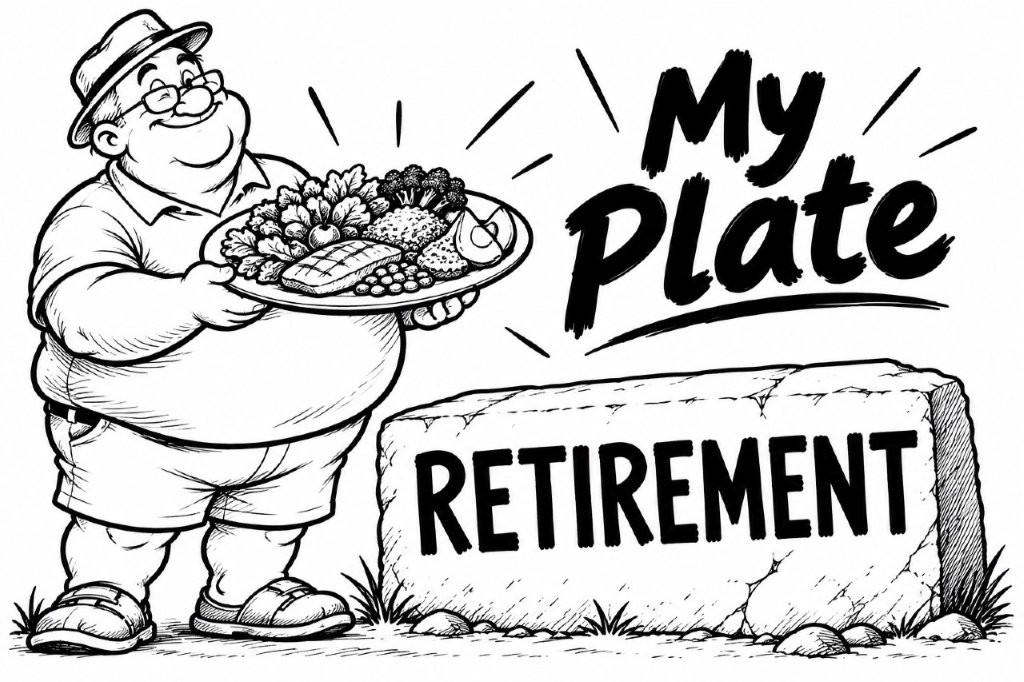
… Your working hours disappear. Your daily routine changes. You may become less active. You may also find yourself spending more time at home.
And, of course, spending more time at home can make the kitchen rather convenient!
Perhaps you are still eating much the same way you did when you were working. The difference is that your body may no longer need quite as much energy.
That raises an important question:
What should you actually be eating in retirement?
The answer is not about going on a strict diet or giving up all the foods you enjoy.
Instead, it is about becoming more aware of what you put on your plate, how much you put on it and how often you eat.
Healthy eating in retirement is really about making your food work for you.
Your body still needs good nutrition.
As we get older, our nutritional needs can change.
Older adults often need fewer calories, particularly when they become less active. At the same time, getting enough nutrients becomes increasingly important. In other words, you may need less food for energy while still needing plenty of vitamins, minerals, protein and other nutrients.
That is why simply eating less is not necessarily the answer.
Instead, we should aim to get more nutritional value from the food we do eat.
This means choosing a variety of vegetables, fruit, protein foods, whole grains and other nutritious foods.
It also means becoming more careful about foods that provide lots of calories but relatively few nutrients.
It is not just about eating less.
This is an important distinction.
When you retire, you may naturally become less active. Therefore, your energy requirements can change.
However, that does not mean you should simply cut everything on your plate by half.
Your body still needs good-quality food.
In fact, healthy eating becomes particularly important because we want our food to support the things that matter during retirement:
Energy. Strength. Mobility. Independence. And quality of life.
South African food-based dietary guidelines developed specifically for older adults recommend a varied diet that includes vegetables and fruit, legumes, protein foods, dairy, wholegrain starchy foods in small portions and adequate fluids.
So, let’s make this practical.
What should be on your plate?
There is no single plate that is perfect for every retiree.
Your age, activity level, body size, appetite and health needs all matter. Therefore, the following is best viewed as a simple everyday guide, rather than a medical prescription.
A useful starting point is:
Food on your plate | Simple guide |
Vegetables and salad | About ½ of the plate |
Protein | About ¼ of the plate |
Carbohydrates | About ¼ of the plate |
Healthy fats | A small amount |
The idea is simple.
- Fill most of your plate with vegetables and salad.
- Add a good source of protein.
- Keep your carbohydrate portion sensible.
- Then add a small amount of healthy fat.
Let’s look at each part.
1. Vegetables and salad:
Make them a big part of your plate.
If you want to improve your eating habits in retirement, this is probably one of the easiest places to start.
Instead of making meat, potatoes or rice the main event, make your vegetables and salad a much bigger part of the meal.
Think about variety.
Green beans.
Broccoli.
Spinach.
Cabbage.
Carrots.
Tomatoes.
Pumpkin.
Peppers.
Cauliflower.
Mixed salads.
The more variety and colour you introduce, the more interesting your meals become.
Vegetables and fruit provide important vitamins, minerals and dietary fibre. International guidance recommends plenty of vegetables and fruit as part of a healthy diet.
And there is another advantage.
Vegetables can help you build a satisfying plate without relying on large portions of energy-dense foods.
So, instead of asking:
“How much meat and potato can I fit on this plate?”
try asking:
“How much colour can I put on this plate?”
That small change in thinking can make a surprisingly big difference.
2. Protein:
Don’t forget your muscles.
Protein deserves special attention as we get older.
Protein foods include fish, chicken, lean meat, eggs, beans, lentils, dairy products, nuts and seeds.
Protein helps the body build and repair tissues. It is also important for maintaining muscle.
Why does that matter in retirement?
Because strength matters.
You need your muscles to get out of a chair.
You need them to climb stairs.
You need them when walking.
You need strength and stability for everyday activities.
Therefore, protein should not be something you only think about if you are a gym enthusiast.
It belongs on the retirement plate too.
Good protein choices include:
- Fish
- Chicken
- Meat
- Eggs
- Beans
- Lentils
- Soya
- Plain yoghurt
- Amaas or other suitable dairy products
- Nuts and seeds
The South African elderly dietary guidelines recommend including fish, chicken, lean meat or eggs in most meals and eating beans, split peas, lentils and soya regularly.
3. Carbohydrates:
With Carbohydrates, portion size matters.
Carbohydrates are not the enemy. They can form an important part of a healthy diet and provide energy.
The problem is often portion size and food choice.
Bread, potatoes, rice, pasta, maize meal and other starchy foods can all form part of your meals. However, when the carbohydrate portion takes up most of the plate, there may be less room for vegetables and protein.
That is why portion size matters.
Where possible, choose higher-fibre or wholegrain options such as oats, wholegrain bread, brown rice and other wholegrain foods.
South African guidance for older adults specifically notes that wholegrain starchy foods can form part of meals in small portions.
So, you do not have to say goodbye to your potatoes. Perhaps just don’t let the potatoes take over the plate!
4. Healthy Fats:
With healthy fats, a little goes a long way.
We also need fat in our diet.
However, fat is energy-dense, so large amounts can add up quickly.
Good sources of unsaturated fats include foods such as nuts, seeds, avocado, oily fish and vegetable oils.
The World Health Organization (WHO) recommends favouring unsaturated fats over saturated and industrial trans fats.
The important word here is moderation.
A small amount of olive oil on your salad is one thing.
Pouring generously over everything is another.
A small handful of nuts can be a nutritious addition.
Eating handful after handful while watching television is a different story.
That brings us neatly to another retirement eating habit that deserves attention.
Snacking.
We will look at that in a separate post.
What about fruit?
Fruit is an important part of a varied diet.
However, fruit is sometimes treated as though it belongs in the same category as sweets because it contains natural sugar. Well, it doesn’t.
Whole fruit provides fibre and a range of vitamins and minerals. WHO recommends regular consumption of fruit and vegetables as part of a healthy diet. So, enjoy your fruit like an apple, an orange, a pear, berries, peaches, whatever is available and suits you.
However, remember that whole fruit and fruit juice are not quite the same thing. Most fruit juices off the shelf are stuffed with refined sugar.
What about sugar?
Sugar is everywhere. And retirement can make it particularly easy to enjoy a little too much of it.
A rusk with coffee.
A biscuit with tea.
A slice of cake.
A sugary drink.
A dessert after dinner.
None of these foods needs to disappear completely from your life.
However, added or free sugars should be kept low. It is recommended that free sugars be limited to less than 10% of daily energy intake, with further reduction providing even additional health benefits.
The South African guidelines for older adults also recommend using foods and drinks high in sugar sparingly.
The key word is sparingly.
Healthy eating does not mean that retirement has to become a punishment.
It means that treats should be treats rather than everyday staples.
Portion size matters more than you may think.
Now we come to another important part of healthy eating in retirement.
How much are you eating?
You can eat nutritious food and still eat too much of it.
This is particularly easy when portions have gradually become larger over the years.
Perhaps your plate has grown.
Perhaps you automatically take a second helping.
Maybe you eat quickly and don’t give your body enough time to register that you have had enough.
Instead, try a few simple changes.
Serve your food before sitting down.
Put your portion on the plate and leave the serving dish in the kitchen.
Use a slightly smaller plate
It can make a surprisingly big visual difference.
Eat slowly
Take your time.
Enjoy your food.
Give your body a chance to register what you are eating.
Wait before taking seconds
Finish your meal and give yourself a few minutes before deciding whether you really need more.
Pay attention to hunger
Ask yourself:
“Am I still hungry, or am I simply enjoying the food?”
That question can be surprisingly useful.
Healthy eating does not mean boring food.
Let’s be realistic.
You are retired.
You have spent decades eating food you enjoy.
You are not going to suddenly live on lettuce leaves and steamed broccoli.
And you don’t need to.
Healthy eating should still be enjoyable.
You can enjoy a braai.
You can have a restaurant meal.
You can eat dessert.
You can have a piece of birthday cake.
The difference lies in the overall pattern.
If most of your meals are nutritious and your portions are sensible, there is room for enjoyment.
Healthy eating is not about perfection. It is about what you do most of the time.
A simple retirement plate to remember:
When you stand in front of the kitchen counter tonight, you don’t need a complicated nutritional formula.
Just remember this:
- Half vegetables and salad.
- A quarter protein.
- A quarter sensible carbohydrates.
- A small amount of healthy fat.
Then add fruit regularly, drink enough suitable fluids and keep foods high in added sugar, salt and unhealthy fats to a minimum.
These principles broadly reflect the emphasis of South African and international healthy-eating guidance, while recognising that individual nutritional needs differ.
Your retirement food reality check.
So, here is a little challenge.
Tonight, look at your dinner plate before you start eating.
Don’t judge it.
Just look at it.
Ask yourself:
How much of this plate is vegetables or salad?
Where is my protein?
How much starch or carbohydrate have I served?
Have I added more fat than I really need?
And perhaps most importantly:
Is this meal helping me become the person I want to be in retirement?
This last question goes beyond food, because retirement is about more than simply stopping work.
Retirement is about having the health, strength, and energy to enjoy the life you now have the time to live.
Healthy eating is part of taking ACTION
In my earlier post, ACTION: Don’t Let Retirement Turn You Into a Sloth, I looked at the importance of taking action to protect our health, mobility and quality of life during retirement.
Healthy eating is one part of that action.
It doesn’t require a dramatic change, but taking action in the right direction starts with your next meal.
The goal is to eat better so that you can enjoy retirement for longer.
 …One Last Question.
If something happened to you today…
Would your family know what to do tomorrow?
Most families don’t.