The one thing that you do not want to lose during your retirement years is your medical aid.
But the question is, do you realise how much medical aid premiums and healthcare can become in retirement, and will you be able to afford it?
..this will make you sit on the tip of your chair!
By looking back at the past, we can make a guess at what to expect in the future.
This series was written specifically for you — whether you’re five years from retirement or already enjoying your years of freedom. It is practical, plain-spoken, and South African. No jargon and no advice. Just plain information you want to know for your own well-being.
This is part 4 about: You Must Realise How Much Medical Aid Premiums Can Become in Retirement.
Please read the DISCLAIMER from the link near the bottom of the page.
Let us talk real numbers. One of the most common mistakes retirees make is budgeting for today’s medical aid premium without accounting for how dramatically those costs will grow over a 20 to 30-year retirement. If you retire at 60 and live to 88 — which is increasingly common — you’ll be paying that premium for nearly three decades.
What You Are Paying Now vs What You Will Pay Later.
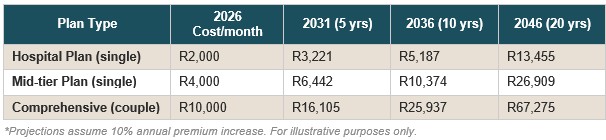
In 2026, a basic medical aid hospital plan for one person costs between R1,300 and R2,500 per month. A mid-tier plan with chronic benefits sits between R3,000 and R5,000. A comprehensive plan for a couple can easily exceed R10,000 per month. And these premiums increase by 8–10% every single year.
⚠ WATCH OUT: Look carefully at that 20-year column. A couple on a comprehensive plan could be paying over R67,000 per month in medical aid premiums alone by 2046. Even at 6% annual increases, the numbers are sobering. Your retirement income plan must account for this escalation from day one.
Get The Full Picture:
All Your Healthcare Costs in Retirement.
Your medical aid premium is just one part of your healthcare spend in retirement. To build an accurate budget, you need to account for all of the following:
- Medical aid premium — Your biggest single healthcare cost. Review annually.
- Gap cover premium — R400–R1,000/month. Essential if you see specialists.
- Co-payments & levies — The amount you pay at point of service even with medical aid.
- Medicines not on formulary — Branded or specialist drugs your scheme won’t cover.
- Dental treatment — Implants, root canals, crowns — massively expensive without cover.
- Optometry — Glasses, contact lenses, cataract surgery — costs rise with age.
- Hearing aids — R8,000–R40,000 per unit; schemes rarely cover the full cost.
- Physiotherapy & rehabilitation — Particularly after surgery, strokes, or falls.
- Home care or frail care — The biggest potential cost — is covered in Post Number 7.
💡 KEY INSIGHT: A safe retirement healthcare budget rule of thumb: assume that your total healthcare spend — premiums plus out-of-pocket — may represent 15–20% of your gross monthly retirement income, which may be rising to 25–30% in your late seventies and beyond.
Next…
The next post in the series will explain:
If Retirees should have GAP Cover
As you will want to know more, all you have to do is to subscribe to this series below.
You may unsubscribe at any given time from future posts.
PS: We are not medical aid brokers or financial advisors and will not try to sell you any medical cover. This series is for informational purposes only.
No spam. No clutter. Just useful information, or:
Click here to stay informed through our spam free WhatsApp Channel.
Added Privacy:
Followers and Admin can’t discover your phone number from this channel.
…One Last Question.
If something happened to you today…
Would your family know what to do tomorrow?
Most families don’t.
Get your own personal simple affairs organiser — so your family never has to guess.